


What I Learned on the Streets of Greenville

What I Learned on the Streets of Greenville
For 27 years, Deb Richardson-Moore was a reporter at The Greenville News. She loved going out, hearing people's stories, and bringing them back to the page. She never planned on a second act. But when she eventually left the newsroom, finished seminary, and walked into the run-down inner-city ministry that was Triune Mercy Center, she found that the thread running through her whole life (listening, writing, sitting with people) was the very thing the work required.
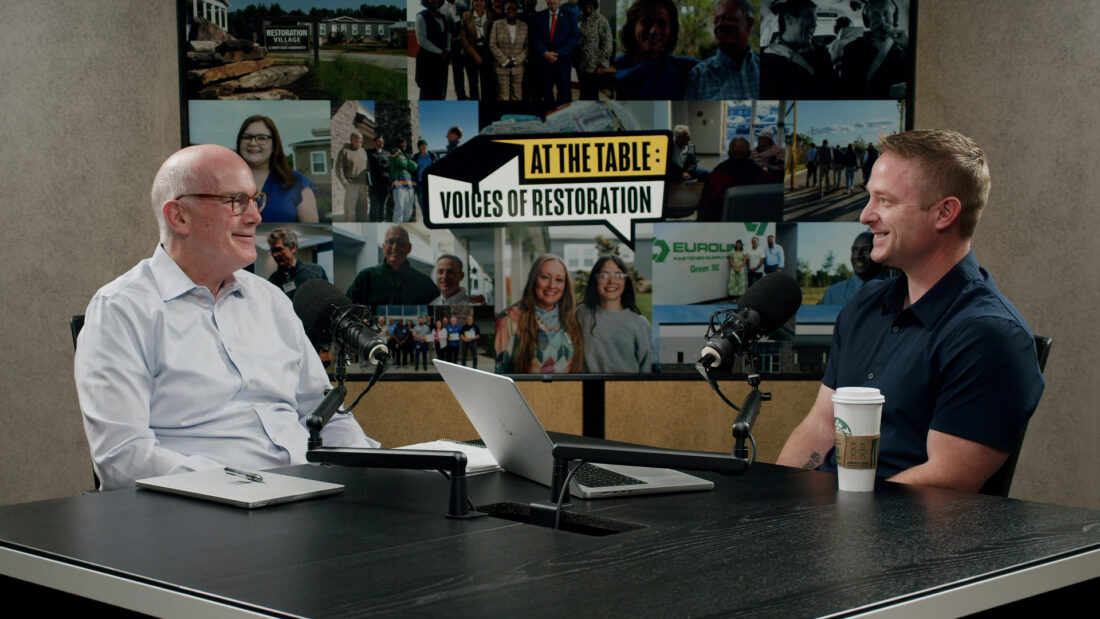
We sat down with Deb to talk about her years leading Triune, what she learned about homelessness and dignity, and what she'd say to anyone who wants to do this kind of work well. What follows is drawn from that conversation.
Connecting the seasons
Looking back, Deb sees her career as one continuous calling rather than a series of pivots.
"Listening to people and writing was always a connector. I never thought it would lead from journalism into ministry. But so many of the people I met had never been listened to. Just being a safe space, where someone could give you their hurts and their traumas and not be judged for it, that turned out to be the work."
She'd wanted to write since she was a kid. ("I thought I'd sooner be a hog farmer or a bullfighter than a minister, and then I became one anyway.") When The Greenville News eventually asked her to cover religion, she enrolled in seminary thinking she'd study comparative religion. Her first New Testament class changed the trajectory. "I'd always wanted this," she said. "I just didn't know where you went to study it." She kept praying, God, I know you're not calling me into ministry, but… Until, eventually, she was.
What she didn't expect
Deb went into Triune expecting to encounter mental illness and addiction. She wasn't wrong about that. But there was another group she hadn't anticipated.
"What I was not expecting was people who had been formerly incarcerated, otherwise healthy, and could not find jobs or housing. Our society says you've paid your debt, but we don't act like it."
Triune poured years into helping people find work. They partnered with other agencies, job programs, anyone who would take a chance. They'd land one placement here, one there. Then an employer told her plainly: I can't hire one of your guys and risk being liable if something happens on the factory floor. That was the wall.
"Employment was the linchpin," Deb said. "Housing was huge, but employment was the thing we couldn't crack."
We asked Deb about the spiritual aspect of unemployment, and how it shapes a person's sense of self.
She remembers a man at Triune who was hired by a board member with a construction company. "He was a hard worker, and they made over him -- thanking him, complimenting him -- something fierce. Subcontractors started calling and saying, if he ever has to leave for any reason, we want him. You see somebody blossom under that kind of praise."
"The worst thing about being homeless"
Deb's most quoted line, the one that ended up shaping her later novels, came from a homeless man she met early in her ministry.
"He told me the worst thing about being homeless isn't being cold or wet or hungry. The worst thing is being looked right through."
That stuck. It became the operating principle at Triune: eye contact, handshakes, anything that says we see you, and our community would be poorer if you weren't here. "We can't solve all your problems," she'd tell people. "But you have a place here, no matter what."
It also seeded her fiction. Her later murder mysteries grew out of a simple thought experiment: what would a group of unseen people know about the things happening in their town that the rest of us miss?
Why simple solutions usually fail
A lot of well-meaning churches and individuals show up to "do something" about homelessness, usually with food, clothes, or shoes. Deb is direct about why that often doesn't help.
"In Greenville, food wasn't the problem. Housing was the problem. Jobs were the problem. Mental health was the problem. But people kept showing up with truckloads of shoes. They wanted to feel like they were doing something."
Worse, she said, well-intentioned donations sometimes ended up sold at crack houses to fund the very addictions Triune was trying to help people escape. "You think you're doing good. In reality, you're funding someone's addiction."
Her advice to anyone who wants to help: come alongside someone who's already doing the work. Watch. Learn. Then jump in. It doesn't have to be Triune. It could be a rescue mission, a recovery house, anywhere with people who've put in the years.
What creates sustainable change
We asked Deb what she's seen actually produce lasting change in someone's life. What works for the roughly one in five who really do break out of the cycle.
She told us about a man who had lived on the streets of Greenville for something like 37 years. Addicted, but gentle, and a regular at Triune's worship services. One day he decided he'd had enough. He got clean. A social worker helped him chip away at years of accumulated debt, including back DMV fines, the kind of bureaucratic weight most people don't think about. He bought a car. He lived in the car for a while. And then, eventually, she got him into an apartment.
"He came back to church every single Sunday. Honestly, I don't know how he gave to the ministry, but he did. Still does, from what I hear. I find that kind of enduring relationship remarkable."
The pattern she saw again and again: someone has to believe in the person before the person believes in themselves. And someone has to walk with them through the maze.
On going from incarceration to thriving
This is where Deb circled back to the work JUMPSTART is doing in her conversation with Cary.
"When you explained your story and what you were doing, I thought: that's the missing piece. That is what we never had. We weren't going from the streets of Greenville straight to Restoration Village; your setup runs through the prisons. But I'll tell anybody: you are preventing homelessness in Spartanburg and Greenville and who knows where else. You're catching people on the front end, before they have to become homeless on our streets."
When people ask Deb where they should donate, she says JUMPSTART is one of her top two recommendations every time. "You're laser-focused. You're not trying to be all things to all people. And you don't back away from the gospel, which I know how that can go. Plenty of organizations start out faith-based and then drift, and five or ten years down the road, the faith piece gets yanked away. I made a rule for myself at Triune: I never accepted funding if I thought the funder might come back one day and say you can't pray here anymore."
Even when you think it's too small
A lot of people on the margins of supporting this work, like retirees and folks with modest budgets, wonder whether their $500 or $1,000 really matters. Deb didn't hesitate.
"Look at what this team is doing with a little. They're not chasing millions. The housing is basic and nice. The community center is functional, not extravagant. That's exactly how it should be. You can do amazing things with $10,000, $20,000 when the people running it are this practical."
To anyone tempted to buy happiness
We asked her what she'd say to Christians who genuinely believe but keep trying to buy meaning through shopping or travel.
"It's hard to even put into words, because if you haven't been in it, you don't know what you're missing. Watching a welcoming team (staff, volunteers) change someone's life? That's something you don't get to do every day. Being part of that was the most magnificent part of my life."
Her recommendation: start by volunteering. Not writing a check. Show up. Be in the room. See it. That's almost always when people decide they want to invest the rest of their time and resources here.
To the people doing the work
Finally, we asked Deb what she'd say to anyone (volunteers, mentors, anyone in the trenches) who's been at this long enough to feel the weight.
"Find the balance."
She talked about the role of laughter at Triune, and how an organization that does heavy work needs to be a place where people also get to laugh together. "Some stuff is just so ridiculous you have to laugh. We had a guy once go a little crazy in the dining hall, run over to the church side, and start pounding on the doors yelling, I'm applying for religious asylum! You just have to laugh."
What gives her hope now, she said, is watching people who could have walked away choose to stay. Retired social workers coming back into the workforce. Good people deciding to try one more time.
"That's what gives me hope. People who could just walk away, and don't."
Watch the Full Interview here:
About Deb
Deb Richardson-Moore is the former leader of Triune Mercy Center in Greenville, South Carolina, a non-denominational mission church that includes homeless and housed parishioners in one worshiping community. A graduate of Wake Forest University and Erskine Theological Seminary, she spent 27 years as a journalist at The Greenville News before her second career in ministry.
Her memoir The Weight of Mercy: A Novice Pastor on the City Streets recounts her first years at Triune and has been used in coursework at Harvard and Duke Divinity Schools. She is also the author of the Branigan Powers mystery series, which draws on the world she came to know through her ministry.